Have you ever followed a recipe, used all the right ingredients, and still felt that something wasn’t quite right?
The garlic tasted bitter. The vegetables became too soft. The sesame oil’s aroma disappeared into the background.
Sometimes, the difference comes down to timing.
When I cook, I pay attention to more than how many minutes something needs. I watch when to add an ingredient, when to change the heat, and when to take something out of the pan.
These small decisions can change the flavour and texture of a dish.
Cooking time and timing are different
Cooking time tells you how long: simmer for ten minutes, or stir-fry for three.
Timing tells you when: add the garlic after the onion has softened, or finish with sesame oil after turning off the heat.
Both matter. But a number on a timer doesn’t tell you everything happening in your pan.
Your stove, pan, ingredient size, and the amount you’re cooking can all affect how quickly food cooks. That’s why I find it useful to look, listen, and smell as I go.
Garlic: watch what happens in the pan
Garlic appears in many Korean dishes, but it doesn’t always belong at the beginning.
When frying finely chopped garlic in oil, watch it closely. It can move quickly from fragrant to burnt, especially over high heat.
For some stir-fries, you might cook firmer ingredients first and add the garlic later. In soups and stews, garlic can go into the liquid and cook with the other ingredients.
The useful question is: what do I want the garlic to do in this dish?
Follow the recipe’s method, then watch for the changes it describes. If the garlic is darkening rapidly, adjust the heat rather than waiting for the timer.
Vegetables: add them according to the texture you want
Putting every vegetable into the pan together is convenient, but they may not finish cooking together.
Carrot slices often need more time than delicate leafy greens. Thick pieces need more time than thin ones.
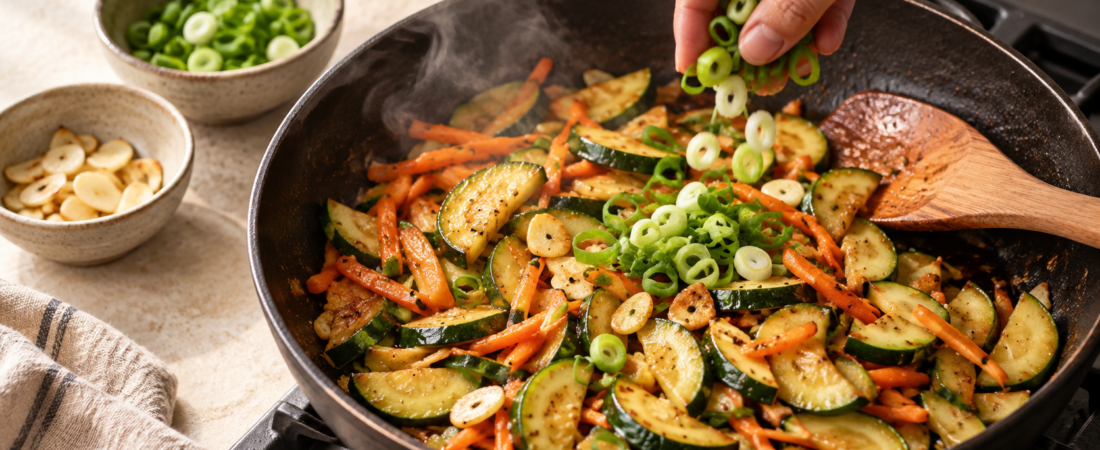
When making a Korean vegetable stir-fry, think about which ingredients need a head start and which only need a brief cook.
You don’t need to memorise a rule for every vegetable. Start by asking:
How thick have I cut it?
How firm is it?
Do I want it soft, tender, or slightly crisp?
The answers help you decide when it belongs in the pan.
Sesame oil: think about its role
In many Korean dishes, toasted sesame oil is used near the end for its aroma.
For a dish such as a seasoned vegetable side dish, it may be mixed in after the vegetables have cooked. In some stir-fries, a little is added as a finishing touch.
Other recipes use sesame oil earlier, so “always add it last” is too simple.
Instead, notice whether the recipe uses it for cooking, seasoning, or finishing. That helps explain the timing.
Spring onion: one ingredient, different moments
Spring onion can play more than one role in the same dish.
The white part can be cooked earlier to build flavour. The green part can be added later for a fresher taste and colour.
You might use both in a soup or stir-fry, adding them at different stages.
This is one of the useful things about understanding timing: you can get different results from an ingredient you already have.
Taking food out is part of timing too
Timing isn’t only about adding things.
If one ingredient is ready before the others, you can take it out and return it to the pan later. This can be helpful when cooking several components for a dish such as bibimbap.
It also helps you avoid leaving cooked vegetables in the pan while you wait for something else to finish.
A recipe’s sequence often has a purpose. Understanding that purpose makes the steps easier to follow.
One thing to try next time
Before cooking your next Korean recipe, read the method once and identify three moments:
What goes in first?
What needs watching closely?
What goes in near the end?
Then look for the recipe’s cues—such as softened onion, fragrant garlic, or tender vegetables—alongside the cooking time.
You don’t have to get every decision perfect. Start by noticing what changes in the pan.
For me, cooking with confidence means understanding those moments: what an ingredient needs, what it contributes, and when to act.